





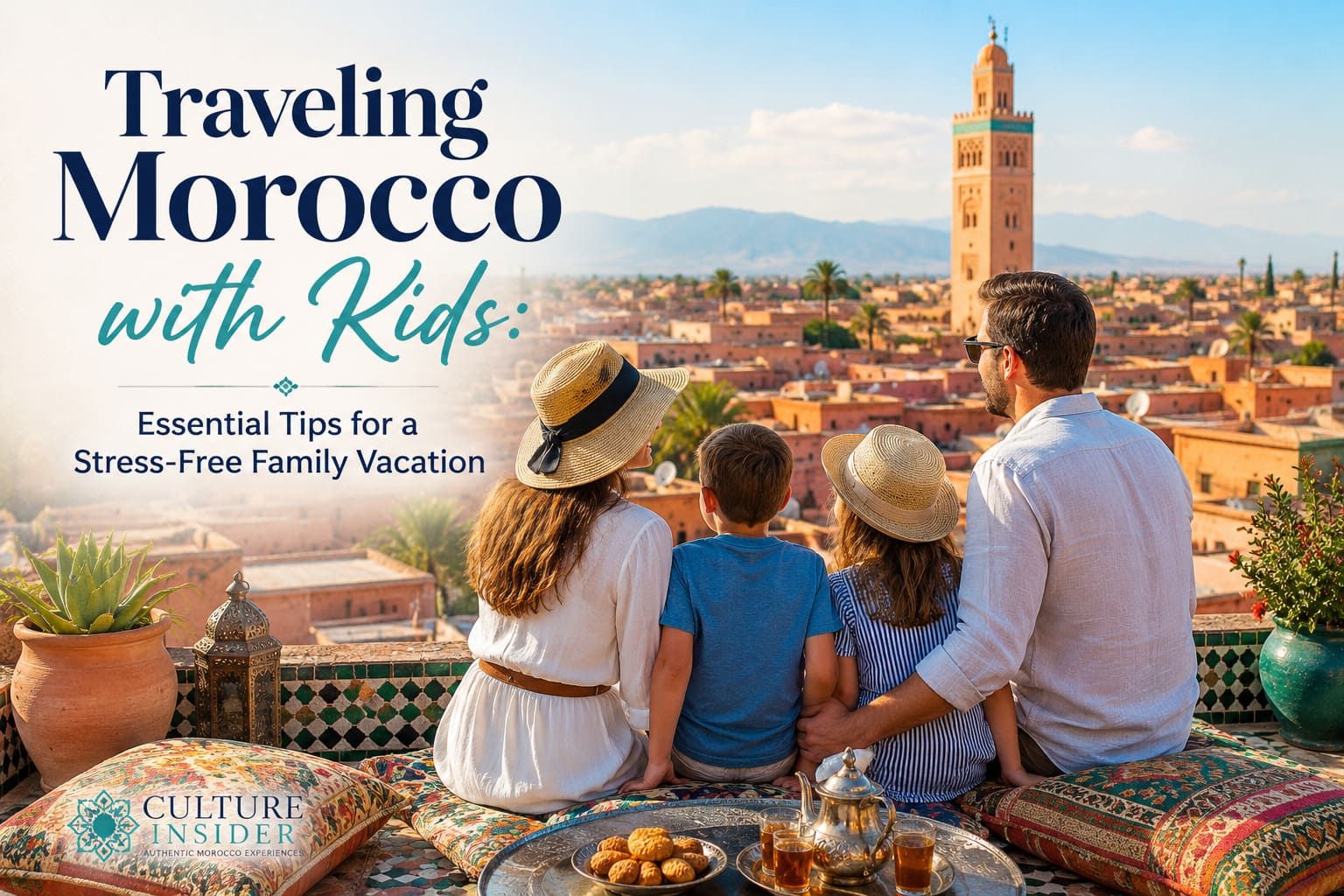
The first family we ever took into the Marrakech souks made it about eleven minutes. Their six-year-old — who’d been fine on the flight, fine at the riad, delighted by the fountain — hit a wall of noise, motorbikes and cumin and simply sat down in the middle of a derb and cried.
We changed two things the next morning. We went in at nine instead of noon, and we gave him a job: find five things that were blue. He came out with a photo of a door, a taxi, a tiled fountain, a plastic bucket and a man’s jacket, and he talked about that walk for the rest of the trip.
That’s more or less the whole lesson. Morocco is a wonderful country to bring children to, and almost every problem families run into here comes down to timing and pacing rather than the destination itself. This guide covers what we’ve learned planning private family journeys — when to come, where to stay, how to handle the drives, what your kids will actually eat, and the mistakes that turn a great trip into an exhausting one.
Why Morocco Is a Fantastic Destination for Families
Moroccan culture is openly child-centred in a way that catches British, American and Australian parents off guard. Waiters will carry your toddler off to meet the chef. Shopkeepers hand over pastries. A crying baby in a restaurant produces sympathy, not glares. For parents used to apologising for their children in public, it’s a genuine relief.
The geography helps too. You can be riding camels on a beach in the morning and walking in the High Atlas the next afternoon, and Marrakech is roughly three and a half hours from London with no meaningful jet lag. Because private drivers and licensed guides cost a fraction of the European equivalent, the logistics that make family travel hard elsewhere are affordable to solve properly here.
When Is the Best Time to Visit Morocco with Kids?
Spring and autumn, without much argument. April, May, September and October give you warm days, cool evenings and a desert that’s pleasant rather than punishing.
The complication is that most families are tied to school holidays, and July and August are the two months we’d steer you away from inland. Marrakech regularly passes 40°C, and the Sahara is genuinely unsafe for small children in high summer. That doesn’t rule out a summer trip — it changes its shape. A July itinerary weighted toward Essaouira, Oualidia and the Atlas Mountains works beautifully, because the Atlantic coast stays in the mid-20s and altitude does the rest.
| When | Inland cities | Coast & mountains | Family verdict |
|---|---|---|---|
| Mar–May | Warm, comfortable | Cool coast, green Atlas | Best overall window — book early |
| Jun–Aug | 38–45°C; avoid the desert | Coast mid-20s, breezy | Go coastal and high, skip the Sahara |
| Sep–Oct | Warm, softer light | Sea still warm | Second-best window; ideal for the dunes |
| Nov–Feb | Cool days, cold nights | Snow on the Atlas | Fine for cities; desert nights near freezing |
Ramadan shifts by roughly eleven days each year. Travelling then is perfectly workable and often lovely, but daytime restaurant closures outside hotels are a real nuisance with hungry children — check the dates before you book.
Planning Your Family Itinerary
The biggest predictor of whether a family trip here goes well is how many nights you spend in each place. Parents arrive with a list of nine destinations; we spend the first call talking them down to four.
Three rules we apply at Culture Insider to every family itinerary we build:
- Cap the driving. With children under ten, keep it under three and a half hours on any given day. Beyond that, everyone stops enjoying themselves — including the adults.
- Stay put longer. Two nights minimum, three where you can. One-night stops mean packing every morning, which is where family holidays go to die.
- Alternate intensity. A loud souk day followed by a pool day. A desert night followed by a slow morning. Children can handle a great deal of stimulation if there’s a recovery day attached.
Choosing the Right Cities
Not every Moroccan city suits every age, and this is where a lot of first-time family trips go wrong. Fes is our favourite city in the country, and we’d still hesitate to recommend it for a four-year-old: the medina is steeper and denser than Marrakech, and there’s nowhere to run.
| Place | Sweet spot | Why it works | What to plan around |
|---|---|---|---|
| Marrakech | All ages | Gardens, pools, souks, day trips in every direction | Intense at midday; choose a riad with a pool |
| Essaouira | 2–12 | Flat, walkable, beach, very little hassle | Windy — bring layers, not just swimwear |
| Atlas Mountains | 4+ | Space to run, mule rides, river valleys | Winding roads; watch for car sickness |
| Sahara (Merzouga) | 6+ | The trip’s headline memory for most kids | Long transfer; cold nights Nov–Feb |
| Aït Ben Haddou | 5+ | A real fortified village kids can climb through | Little shade — go early |
| Fes | 10+ | Craft workshops, history, extraordinary depth | Steep, dense, impossible with a stroller |
| Chefchaouen | 6+ | Blue streets, cats, easy exploring | Four hours from Fes — needs two nights |
Ages are guidance, not rules. A calm six-year-old often does better in Fes than a restless eleven-year-old.
Transportation Tips
Car seats are the detail almost nobody checks. They aren’t standard in Moroccan taxis or most rental cars, and they can’t be assumed on a private transfer either — they have to be requested in writing, with your children’s ages and weights, well before you arrive. Some families bring their own; that’s never a bad decision.
A few things worth knowing about getting around:
- Petit taxis. These are legally limited to three passengers, so a family of four can’t ride together. It surprises everyone. Use a grand taxi or a private car instead.
- Trains. Al Boraq between Tangier, Rabat and Casablanca is fast, clean and easy with children. Conventional trains to Fes and Marrakech are comfortable in first class and let kids move around.
- Domestic flights. Cheap and frequent between Casablanca, Marrakech, Fes, Errachidia and Ouarzazate. One flight can buy back an entire day of driving — often the best money you’ll spend.
- Medina access. Cars can’t enter the Fes medina or much of the Marrakech medina. Riads use porters with handcarts, and it’s a five- to fifteen-minute walk in. Ask about this before you book, not after.
Family-Friendly Accommodation
Riads vs Hotels
A riad is a courtyard house that turns inward — cool, quiet, usually eight to fourteen rooms, with staff who’ll know your children’s names by the second morning. That intimacy is the appeal, and for families with school-age kids it’s often the better choice. But riads were built as private homes, not as hotels for toddlers, and there are three things we check on every single family booking.
- Courtyard plunge pools are frequently unfenced and often deep right at the edge.
- Traditional stairs are steep, tiled and rarely gated.
- Rooftop terraces sometimes have low parapets. This is the one parents never think to ask about, and it’s the one that matters most with under-fives.
Ask for photographs of the courtyard, the staircase and the roof before confirming; any good riad sends them without hesitation. With very young children, a Palmeraie resort or a hotel outside the medina walls — lifts, level ground, a fenced pool, vehicle access to the door — is usually the smarter Marrakech base, with a riad saved for Fes or Essaouira.
One structural warning: connecting rooms are scarce. Luxury riads are small and family configurations sell out first, so twelve months ahead is not excessive for a spring or autumn trip.
Keeping Children Comfortable During Long Drives
The Tizi n’Tichka pass between Marrakech and Ouarzazate climbs to 2,260 metres through a long series of hairpins. It’s spectacular and it makes people sick. If anyone in your family is prone to motion sickness, medicate before you set off rather than after the first bad bend.
What works, in our experience: leave by eight to clear the mountains before the heat; stop every ninety minutes even when nobody’s asked; download films and audiobooks in advance, because signal drops out across the Atlas; and keep a change of clothes in the car rather than the boot.
| What we’ve learned: Brief your driver on day one. Tell him your children’s names, when they usually nap, and what the warning signs look like. Moroccan drivers on the private circuit are used to families and will start suggesting stops before you do — but only if they know what to watch for. |
Health & Safety Tips
Morocco is a safe country to travel through with children. The realistic issues are mundane ones: sunburn, upset stomachs and getting separated in a crowd.
- Water. Stick to bottled or filtered water for drinking, and for brushing teeth with younger children. Ice in reputable restaurants and hotels is generally fine.
- Stomach upsets. Pack oral rehydration sachets before you leave home — they’re the single most useful item in a family medical kit, and much easier to find at your own pharmacy than to explain in a foreign one.
- Sun. High SPF, hats and long sleeves. The desert and the mountains both burn children faster than parents expect, because the air is cool while the sun is not.
- Animals. Morocco has a lot of street cats and children want to pet all of them. Rabies exists here. Teach the rule before you arrive: look, don’t touch.
- Vaccinations. Check routine immunisations are current and talk to a travel clinic about hepatitis A and typhoid, which are commonly recommended for Morocco. Do this six to eight weeks ahead.
- If something goes wrong. Moroccan pharmacies are excellent and pharmacists are highly trained — they can handle most minor issues without a doctor. Private clinics in Marrakech and Casablanca are good. Take travel insurance that includes medical evacuation.
For crowds, the practical move is a photograph. Take one of each child every morning in what they’re wearing that day, and write your phone number on a card in their pocket. In Jemaa el-Fnaa after dark, that’s worth more than any amount of hand-holding.
Food Kids Usually Enjoy
Here’s the reassurance most parents need: Moroccan food is aromatic, not spicy. Cinnamon, cumin, saffron and ginger do the work. Harissa, the chilli paste, is served on the side. Fussy eaters do far better here than in Thailand or India.
The reliable winners are chicken tagine with potatoes and olives, brochettes — grilled meat skewers, essentially kebabs — and bread, which arrives with everything and which children will happily live on. Breakfast is a strong point: msemen, a flaky folded pancake, and beghrir, a spongy semolina pancake, both served with honey and butter. Fresh orange juice is everywhere and cheap; ask for it without added sugar.
Couscous is traditionally a Friday dish, so don’t be surprised when it isn’t on Tuesday’s menu. And teenagers tend to love being dared to try the snail broth at the Jemaa el-Fnaa food stalls.
Packing Essentials
- A soft carrier for under-threes rather than a stroller. Medina lanes are worn stone, often stepped, and strollers are miserable in them.
- Closed shoes with grip for everyone. Medina alleys are frequently wet.
- A warm layer per person, even in spring — desert and mountain nights drop sharply.
- High-factor sunscreen, wide-brim hats, refillable water bottles.
- Children’s paracetamol or ibuprofen, a thermometer, plasters, ORS sachets, wet wipes, hand gel.
- Modest basics: shoulders and knees covered in medinas and religious sites. There’s no requirement for women or girls to cover their hair.
- European two-pin plug adapter (Type C/E, 220V) and a power bank.
- One familiar snack from home per child. It defuses more situations than you’d think.
Cultural Etiquette Families Should Know
Prepare your children for attention. Moroccan adults are affectionate with kids and will ruffle hair, pinch cheeks and ask their names — blond children get a lot of it. If your child would find that alarming, explain it beforehand. It’s warmth, not intrusion, and knowing that in advance changes how they respond.
A few practical points. Greet before you ask; “salam alaikum” opens doors that a direct question won’t. Use the right hand for eating, greeting and passing money. Ask before photographing people, especially women and in rural areas. Shoes come off in homes. Mosques are generally closed to non-Muslim visitors, with the Hassan II Mosque in Casablanca a notable and very worthwhile exception — the guided visit is genuinely engaging for older children.
Teaching kids two words — shukran for thank you and salam for hello — changes how they’re received everywhere. It’s also the easiest entry point into the authentic Morocco experiences that families remember longest: a pottery workshop, a bread-making session, an afternoon with a Berber family in the Atlas.
Best Activities for Children
Marrakech
Go into the souks early — nine or ten, before the crowd and the heat. The Majorelle Garden suits younger children because it’s contained and full of colour, and Jemaa el-Fnaa after dusk is pure theatre: storytellers, musicians, food stalls. A cooking class where kids grind spices and shape their own bread is the most popular half-day we book for families.
Essaouira
The best town in Morocco for young children: flat, walkable, and close to hassle-free. Camel and horse rides run along the beach, the Portuguese ramparts are made for climbing, and the fishing port at midday is free entertainment. Older kids can take a surf or windsurf lesson.
Atlas Mountains
An hour from Marrakech and a completely different country: terraced fields, walnut trees, cold rivers. Short mule treks suit children from about four, and most valley lodges arrange a village walk ending with tea in someone’s home. It’s also where kids get to run, which after two days in a medina matters more than any monument.
Sahara Desert
For children over about six, the dunes at Merzouga are the headline memory of the trip. Sandboarding, a short camel ride into camp at sunset, dinner under a sky with no light pollution and Amazigh drumming afterwards. Keep the camel leg to ninety minutes — three hours is too long for anyone under twelve. Two nights beats one, because a single night means arriving at dusk and leaving at dawn.
Chefchaouen
The blue city is a straightforward pleasure with children: gentle streets, hundreds of cats, and a small waterfall walk at Ras el-Maa where local families picnic. It’s four hours from Fes, so treat it as a two-night stop or skip it — a day trip isn’t worth the drive.
Fes
Best for ten and up. What makes it work for that age is craft: watching a potter throw and a maalem cut zellige tiles by hand, seeing brass hammered in the Seffarine square, standing above the Chouara tanneries with a sprig of mint. Keep the walk to three hours and build in a rooftop lunch.
Sample 10-Day Family Itinerary
This is the route we build most often for first-time families with children roughly six and up. It moves in one direction, never doubles back, and has no single-night stops except the desert.
| Days | Base | The shape of it |
|---|---|---|
| 1–3 | Marrakech | Arrival and pool day. Early souk walk with a guide and a five-things game. Cooking class or the Majorelle Garden. Jemaa el-Fnaa one evening. |
| 4 | High Atlas | Over the Tizi n’Tichka with stops. Short mule ride, river valley walk, night in a kasbah lodge. |
| 5 | Aït Ben Haddou → Skoura | The ksar early, before the heat. Afternoon in the palm oasis with time to swim. |
| 6–7 | Merzouga | Todra Gorge en route. Camel ride into camp at sunset, sandboarding, stargazing, a full day in the dunes. |
| 8–9 | Fes | Fly from Errachidia or drive via the cedar forests. One guided morning in the medina, one free afternoon, a pottery workshop. |
| 10 | Fes → Casablanca | Train or drive, Hassan II Mosque visit, departure. |
Families with under-sixes are usually better off swapping the desert leg for Essaouira and adding a night in Marrakech — the sort of adjustment that shapes most kid-friendly Morocco itineraries we put together.
Common Mistakes Parents Should Avoid
- Trying to see everything. Nine cities in ten days produces a holiday made of car windows. Cut two destinations and add nights.
- Taking a toddler to the Sahara. The dunes are extraordinary and they’re a long way from anywhere. Under-fives are better served by the coast.
- Sightseeing in the middle of the day. Souks, tanneries and open ruins are all far harder between noon and four in summer. Mornings and late afternoons; pool or rest in between.
- Booking a riad without checking the pool, stairs and roof. Beautiful, and a genuine liability with small children. Ask before you book.
- Over-programming. Children need unstructured time. Two guided half-days in a week is usually plenty.
- Assuming car seats will be there. Requesting them on arrival almost never works. Confirm in writing weeks ahead.
Luxury Family Travel in Morocco
Luxury in a family context means something specific here, and it isn’t marble. It’s a driver who knows where the clean bathrooms are between Ouarzazate and Merzouga, a guide who can hold a nine-year-old’s attention for two hours, and a desert camp that puts your family in adjacent tents and feeds children at six rather than nine.
Morocco delivers that unusually well for the money — a suite in a top riad, a private vehicle and a licensed guide cost a fraction of the equivalent in southern Europe, which is why so many families who’d normally travel independently end up choosing Morocco luxury travel experiences here instead. The budget stretches into logistics, and logistics are what make family travel work.
Why Private Tours Make Family Travel Easier
Group departures run to a fixed schedule, and children don’t. The advantage of travelling privately isn’t exclusivity — it’s cutting a medina walk short when it’s clearly over, adding an hour at the pottery workshop because your daughter won’t put the clay down, or leaving at seven because the forecast changed overnight.
It also removes the friction that wears parents out. Families consistently tell us that what they valued most wasn’t any single experience, but the fact that for two weeks they didn’t have to organise anything.
Frequently Asked Questions
Is Morocco safe for families with children?
Yes. Violent crime against visitors is rare and families are treated with real warmth. The practical risks are ordinary ones — sunburn, upset stomachs, getting separated in a busy souk — and a licensed guide removes most of the low-level hassle at medina gates. Photograph your children each morning in the day’s clothes, keep a card with your phone number in their pocket, and check your own government’s current advice before you fly.
What’s the best age to take kids to Morocco?
Six and up is the sweet spot, because that’s when the desert, the mountains and the souks become genuinely exciting rather than overwhelming. We’ve planned very happy trips for families with toddlers, but they look different — weighted toward Essaouira, the Atlas and a resort base in Marrakech rather than long transfers and dune camps. Teenagers do exceptionally well here.
Do I need vaccinations to travel to Morocco with children?
No vaccinations are required for entry from most countries, but health authorities commonly recommend keeping routine immunisations current and adding hepatitis A and typhoid. Book a travel clinic six to eight weeks ahead so any course has time to work. Rabies is present in Morocco, which matters with children and street animals — ask your clinic whether pre-exposure vaccination makes sense.
Can you drink the tap water in Morocco?
Tap water is treated in the main cities and many locals drink it, but visitors’ stomachs often disagree. Use bottled or filtered water for drinking, and for brushing teeth with younger children. Ice in hotels and established restaurants is generally fine. Pack oral rehydration sachets from home — the most useful thing in a family medical kit, and awkward to source mid-trip.
How long should a family trip to Morocco be?
Ten days is the natural length. Seven works if you stay in one region — Marrakech, the Atlas and a coastal stop — and fourteen lets you add Fes or Chefchaouen without rushing. What doesn’t work is compressing a big loop into a week. With children, the number of places matters more than the number of days, so cut destinations before you cut nights.
Is Moroccan food too spicy for kids?
Almost never. Moroccan cooking is aromatic rather than hot — cinnamon, cumin, saffron, ginger — and harissa is served separately. Chicken tagine with potatoes and olives, grilled brochettes and bread are safe bets everywhere, and breakfast pancakes with honey are usually an instant hit. Fussy eaters cope better here than in most long-haul destinations.
Are riads suitable for young children?
They can be excellent, but check three things: whether the courtyard pool is fenced, whether the stairs are gated, and how high the rooftop parapet is. Riads were built as family homes, not childproofed hotels, and roof terraces are the detail parents most often overlook. Ask for photographs before booking. With under-fives, a hotel outside the medina walls is usually easier.
Do I need a car seat in Morocco?
Plan for one. Car seats aren’t standard in taxis or on most private transfers, so request them in advance in writing, with your children’s ages and weights. Plenty of families bring their own, which is never a bad call. Note too that petit taxis are limited to three passengers, so a family of four can’t ride in one together.
Final Thoughts
Morocco rewards families who plan properly and punishes those who over-plan. Pick four places instead of nine. Come in spring or autumn if your school calendar allows it, and go coastal if it doesn’t. Check the pool, the stairs and the roof. Confirm the car seats in writing. Then leave a couple of mornings completely empty, because those are the ones your children will talk about — the hour spent watching a potter, the afternoon nobody had scheduled.
If you’d like help shaping that, Culture Insider plans tailor-made Morocco tours for families from our base in Fes — which mostly means knowing which riad has a gated staircase, which guide is good with nine-year-olds, and where to stop between Ouarzazate and the dunes. Start early for spring and autumn, tell us how you want the days to feel rather than which sights you think you should tick off, and the rest is our job.
About the author Written by the travel team at Culture Insider, a Fes-based specialist in private and tailor-made Morocco journeys, drawing on more than 320 privately guided trips since 2020.
